The Crossflow Years

The purchase of this engine is the steep gradient on the cumulative cost plot, around the end of January 1999. It looked unused (on the outside) and came with all the pumps etc and an unused sport clutch (all already connected) as well as a starter motor, alternator, and Lucas electronic ignition system (still in the box).
The exact history of this engine is not known to me, as it was sold by Fisher Sportscars on behalf of the owner. However, on purchasing it, I obtained the original invoices (from Motoscope). The first invoice, for £1301.69(!) is dated 1st June 1992 and (from what I can read of the awful handwriting) included only the block and its immediate ancillaries, and not the head! The second invoice, which I think is for the head, is for £260.00, and is dated 22nd June 1995.
As far as I can tell from the handwriting and what I discovered during a partial rebuild, the following is a list of 'performance' engine components:
In my installation, carburation was supplied via twin DCOE 40s running fairly large chokes. Exhaust gases were removed via a 4 into 1 large bore tubular stainless steel exhaust manifold (with fairly long primaries) - which connected to the outside world via a straight-through repackable stainless steel silencer. This setup gave much better tractability than my original setup, which had shorter (~32cm) primaries and Cherry Bomb "Muff Diver" silencer).
Ignition was initially supplied via a MkIV Escort (Valencia) electronic ignition (relector sensor) dizzy, which I modified to limit the amount of mechanical advance so that, with the static setting of 15 degrees advance, the maximum mechanical advance didn't exceed 37.5 degrees. The figure below shows the advance curve that I got from this dizzy compared to:
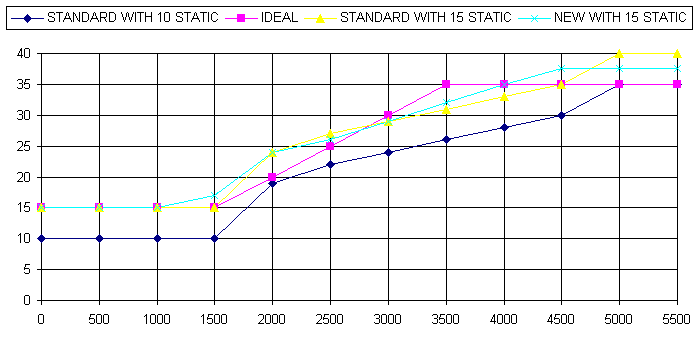
In the figure, the horizontal axis is engine speed in RPM, and the vertical axis is total mechanical advance BTDC.
I also fitted a vacuum advance system, 'T'ing off all four DCOE barrels, which eased the tractability problem that I was experiencing.
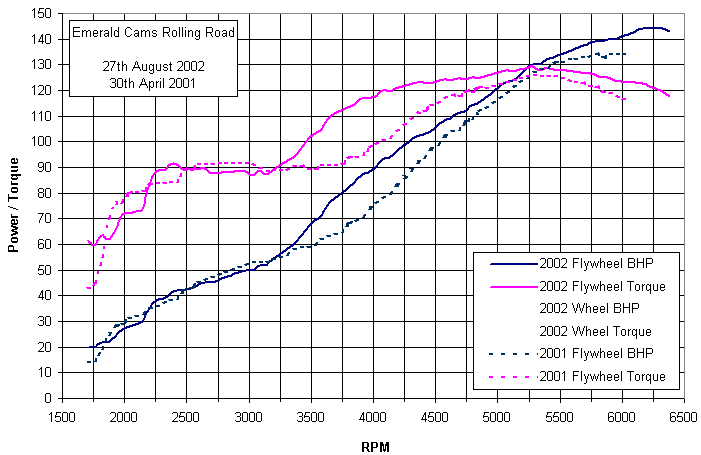
So, what power & torque did this engine produce? Well, below is a plot from the data recorded during a rolling road session at Emerald Cams on 30th April 2001. I was not happy with the hollow part of the torque curve as this indicated that I had been missing out on mid-range grunt - which made the engine inflexible on the road.
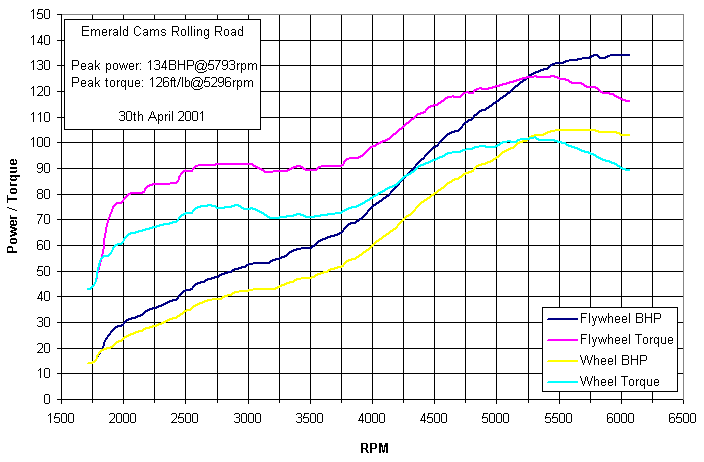
This is what motivated me to replace my Fury's exhaust. On the road, she was much more tractable. Here's what the Emerald rollers said (on 27th August 2002):
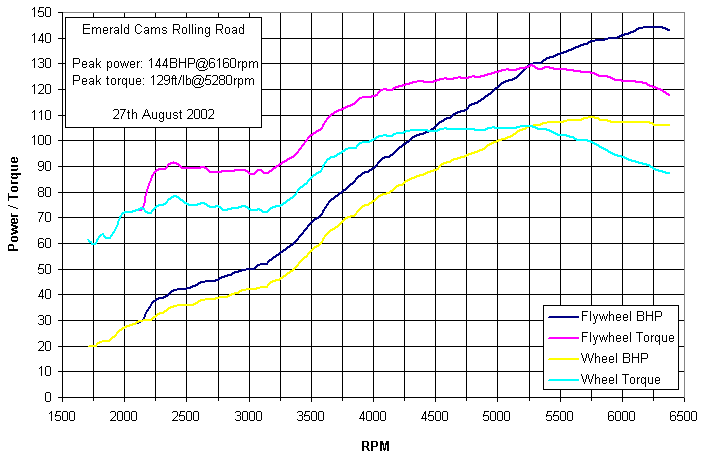
... and here is a plot overlaying the (before and after) flywheel power and torque curves, to show the improvements most effectively:
Following these measurements, I got sucked into the world of GMECM, and from this point on ignition was supplied via a locked MkIV Escort (Valencia) electronic ignition (reluctor sensor) distributor and a General Motors engine management system. The figure below shows the latest ignition map that I used with the Crossflow:

This engine always had a flat spot, when accelerating, between 2000 and 3000rpm. This was fixed on 10th April 2003 simply by me changing the emulsion tubes. It would have been nice if the previous rolling road tuners that I have used had been sufficiently competant, diligent, and knowledgeable enough to have done this. Instead, I drove in disatisfaction for 4 years, and had to solve the problem myself, with help from other car enthusiasts.
In addition, I reduced the air correctors in size to overcome a weakening of the fuel mixture at high RPM.
On the 17th April 2003, just after fitting the new air correctors, I took my Fury for a power run at CC Engines, Reading, who are the new owners of the Emerald Cams rollers. This was to compare current performance with previous performance, on the same rollers.
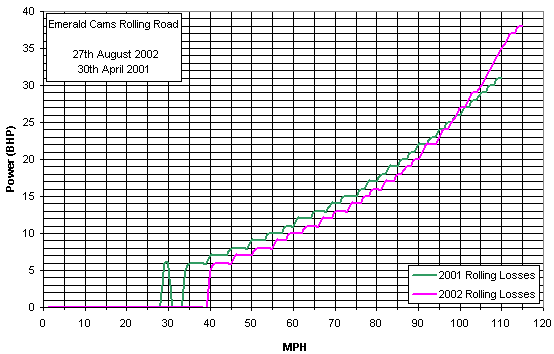
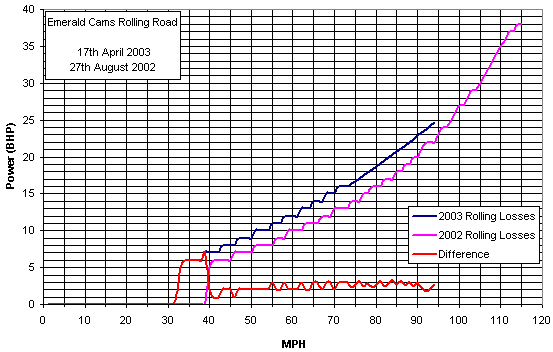
Unfortunately, the measured rolling losses above 5400RPM (72MPH) were invalid. The explanation given for this by the rolling road operator was that the power was still rising at the RPM that I advised him to lift off (7000). Consequently, I extrapolated the valid data by fitting a quadratic to it. The validity of the new data can be seen by comparing the rolling losses, as a function of road speed, between the 2001, 2002, and 2003 power runs (see figures below). Note that the 2003 power run was done in 3rd gear, whereas the 2001 and 2002 runs were done in 4th. Consequently, the maximum speed achieved is lower for the 2003 run, than for the others.
The extrapolated 2003 losses were used to calculate flywheel BHP and torque, plotted in the two figures below. The first figure shows the four new (2003) power and torque curves. The figure below that compares the 2002 flywheel curves with the 2003 flywheel curves. The difference in engine setup between the two are: ignition, emulsion tubes, and air correctors.
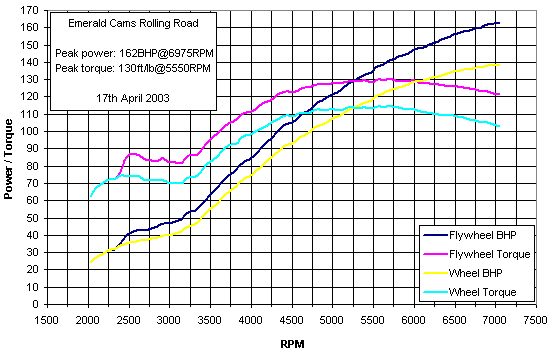
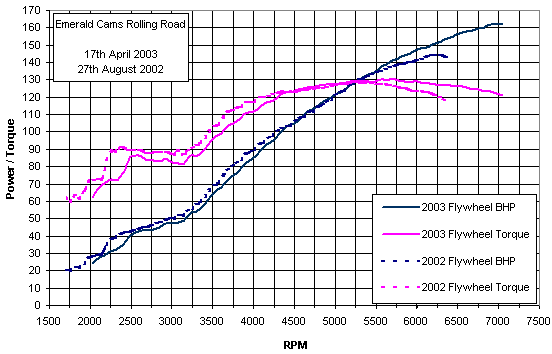
As you can see, the engine now continued to provide more power at higher RPM. In fact, power was still rising at the RPM that I asked the rolling road operator not to exceed. As it is, there is quite a considerable increase in peak flywheel BHP (144 to 162).
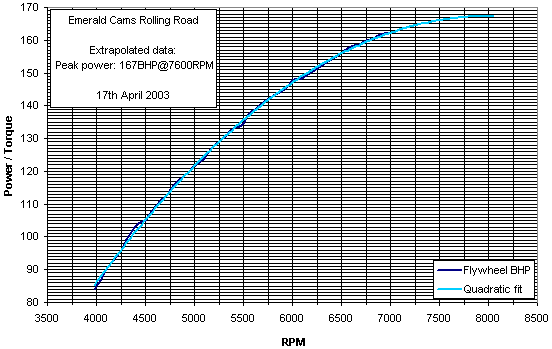
As an exercise, I fitted a quadratic to the upper part of the flywheel BHP curve. This produced a very good fit. I then used the fitted quadratic to extrapolate the flywheel BHP until it stopped rising. The resulting curve can be seen in the figure below. This gives a theoretical peak flywheel BHP of 167, at ~7600RPM.