Engine
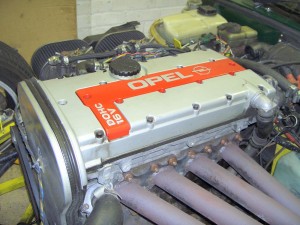
As the Fury was designed for the Ford Kent (Crossflow) engine, this is what I (originally) fitted. The first engine came from the pile of MkII Escort stuff that I bought from my mate, Brian, and was a standard 1600cc, with some simple port smoothing done by me. Disappointed by the lack of grunt from the standard 1600, I bought a tuned 1700cc Crossflow for £850. After getting sick of the Crossflow's continuous rebuilds, heavy breathing, and the general lack of grunt where it matters on the road - at the bottom end - I replaced it with a Vauxhall 2.0 DOHC 16v XE engine, from a 1989 Vauxhall Astra GTE MkII. The XE's cylinder head was designed by Cosworth - and was described to me, by one of the major XE specialist tuning companies, as being good (unmodified) for 230BHP.
The XE that I bought had previously been fitted in a Westfield, but had been sitting in the Westfield owner's garage for a few years, having been replaced by a tweaked XE that came out of a Calibra. According to the previous owner, the engine had only done ~58,000 miles and had been removed as the head had suffered from the common porosity problem between the oil and water ways. This had, apparently, been fixed. Whilst the engine was out, the bores were deglazed (which I verifed, as the head wasn't bolted on to the block), and new rings were fitted. At the bottom end, the big end and main bearing shells were also replaced (allegedly). The engine came with a cut & shut alloy sump (no baffles, but a flat bottom and slightly shallower than the original sump), and a (disovered later to be very badly) modified pick-up pipe. With this sump fitted, the engine measures about 60cm from the bottom of the sump to the top of the oil filler cap.
Unfortunately, this engine dumped oil into: the coolant, 2 of its cylinders, and the ground! So I removed the cylinder head from a scrapped late Cavalier SRi and had it pressure tested. It passed this, so I rebuilt the head and fitted it to my block. None of the problems that I had previously experienced went away so, fed up and wondering if I would ever cure this engine's problems, I bought a complete and running late MkIII Cavalier SRi with a C20XE engine in it (the later incarnation of the 20XE, where 'C' stands for 'Catalyst') for £190 (total bargain compared to how much I spent on a sick engine with no ancillaries). This car was first registered in 1993 and the mileage on the odometer was, unconvincingly, under 90,000. (Co-incindentally, the steering column shroud was held together with black PVC tape as someone had obviously prised it apart so that they didn't have to take the (airbag) steering wheel off!) Still, the car pulled reasonably well and showed no obvious sickness. Compressions were: 217, 227, 226, 222 PSI - so I installed this engine in my Fury.
In my installation, carburation is supplied via twin DCOE 40s running the largest recommended chokes. Exhaust gases are removed via a 4 into 1 large bore tubular mild steel exhaust manifold (with fairly long primaries) - which connects to the outside world via a straight-through repackable stainless steel silencer.
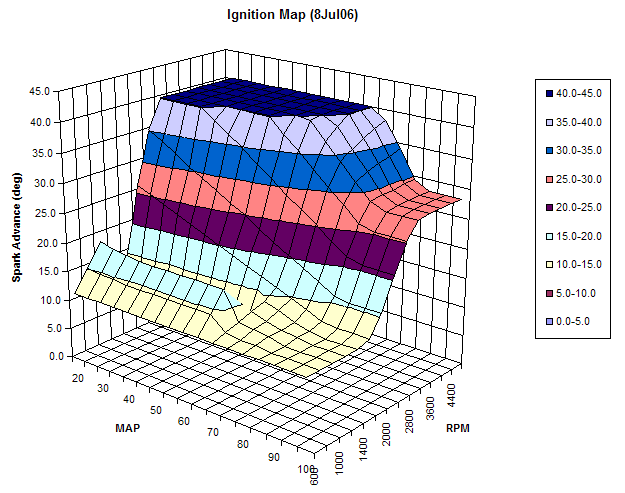
Ignition is supplied via a specially modified Vauxhall distributor in conjunction with an american General Motors engine management system. (When I first installed the engine, I ran it briefly using a non-locked Vauxhall MkII Cavalier Hall Effect electronic ignition distributor with vacuum advance before.) The figure below shows my current ignition map:
So, what power & torque does this engine produce? The plots below show the current engine's flywheel power and torque curves, compared with the final versions for the Crossflow.
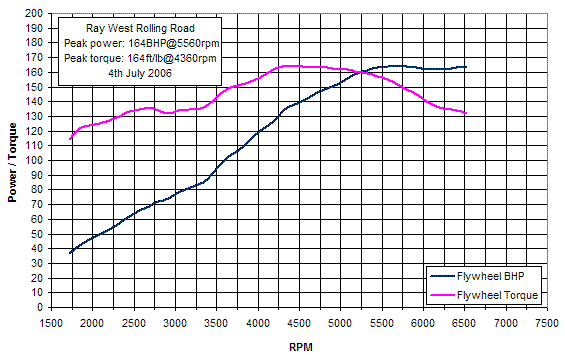
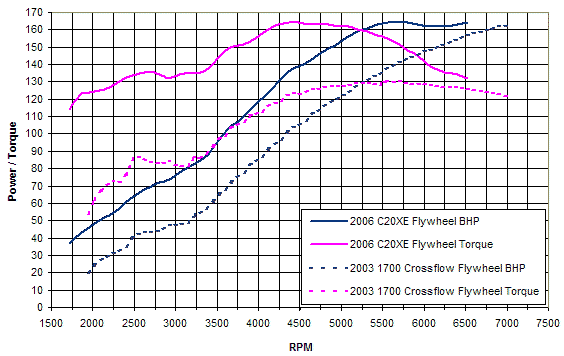
The curves for the XE clearly confirm the expectation that the 36mm chokes in the DCOE 40s are restricting power above 5500RPM (if not earlier). They also confirm how much extra grunt the XE has in the lower half of the RPM range. :-)